
Packaging glassware for the European market requires more than a strong carton. Exporters must consider environmental regulations, material safety, transportation strength and product protection.
Suitable packaging can reduce breakage, meet buyer requirements and help control international shipping costs.
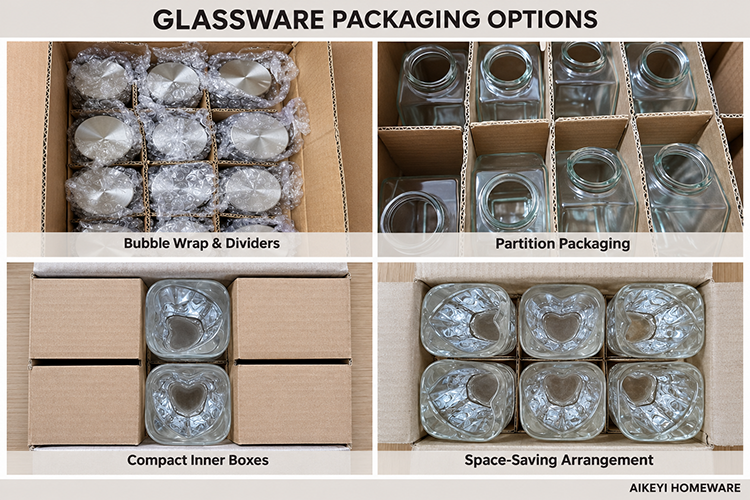
Packaging exported to Europe should comply with applicable EU packaging and waste regulations.
Important requirements include:
The total amount of lead, cadmium, mercury and hexavalent chromium should not exceed 100 mg/kg.
Cartons should be recyclable and should avoid unnecessary plastic coatings or difficult-to-separate materials.
FSC-certified paper may be required by some retailers and importers.
Country-specific EPR registration and recycling marks may apply, such as Germany’s LUCID system and France’s Triman logo.
The importer or brand owner should confirm the exact requirements for each destination country.
If paper packaging directly contacts food, it may need to comply with applicable EU food-contact regulations, including:
Regulation (EC) No. 1935/2004
Regulation (EC) No. 2023/2006
German LFGB requirements
French DGCCRF requirements
If the carton is only used as secondary or transport packaging for glassware, food-contact testing may not always be required.
Printing inks, adhesives, coatings and anti-mould agents should also comply with applicable EU REACH requirements.
Glassware may experience stacking pressure, vibration, impact and repeated handling during transportation.
Common packaging tests include:
Edge Crush Test (ECT)
Bursting Strength Test (BST)
Box Compression Test (BCT)
Drop Test
Vibration Test
Stacking Test
Buyers and e-commerce platforms may require testing according to ISTA or ISO standards.
Common protective packaging options include:
Five-layer or seven-layer export cartons
Cardboard dividers
EPE foam or polyfoam inserts
Bubble bags and protective sleeves
Reinforced inner and outer cartons
Corner protectors
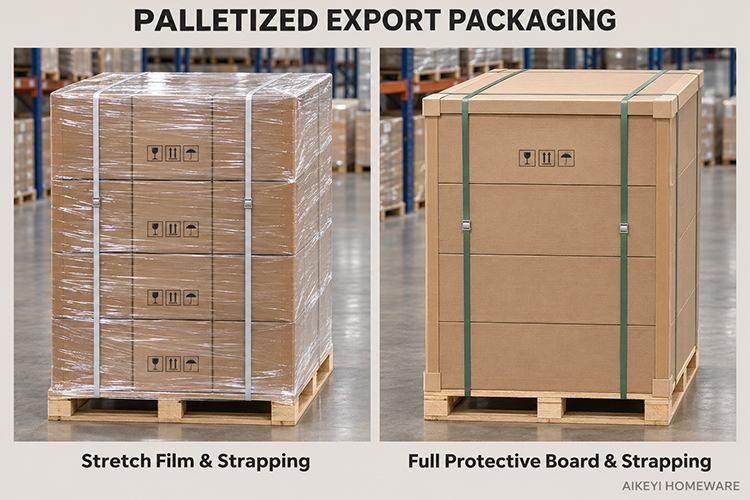
Pallets with stretch film
Wooden crates for heavy or high-value products
LCL shipments should normally be palletized to reduce the risks of crushing, moisture and uncontrolled handling.
Outer cartons may also need product information, carton dimensions, quantity, weight, country of origin and handling symbols such as “Fragile” and “This Side Up.”
Long sea transportation can cause condensation inside the container, commonly known as container rain.
To reduce moisture damage, exporters may use:
Moisture-resistant cartons
Container desiccants
Desiccant bags inside cartons
Protective liners
Pallet wrapping
Suitable container-loading methods
These measures help prevent weakened cartons, mould, stains and damaged retail packaging.
AIKEYI provides customized gift boxes, retail packaging and export cartons for different glassware products.
Our packaging options include:
Custom printed color boxes
Gift boxes and private-label packaging
FSC-certified paper materials upon request
Cardboard dividers
EPE foam and molded protective inserts
Reinforced export cartons
Barcodes, labels and recycling marks
Palletized packaging for international transportation
We can also help customers analyze which packaging structure is most suitable for their products and sales channels.
Our team considers product protection, retail presentation, carton size, packing quantity and container utilization. By improving the arrangement of the products and cartons, we aim to reduce unnecessary packaging space, load more products into each shipment and help customers control sea freight costs.
Packaging samples, drop tests and compression tests can be arranged before mass production according to the buyer’s requirements.
Looking for suitable packaging for your glassware project? Send us your product dimensions, quantity, destination country and packaging requirements.
Email: info@aikehomeware.com
WhatsApp: +86 135 9017 5220
Website: www.aikehomeware.com